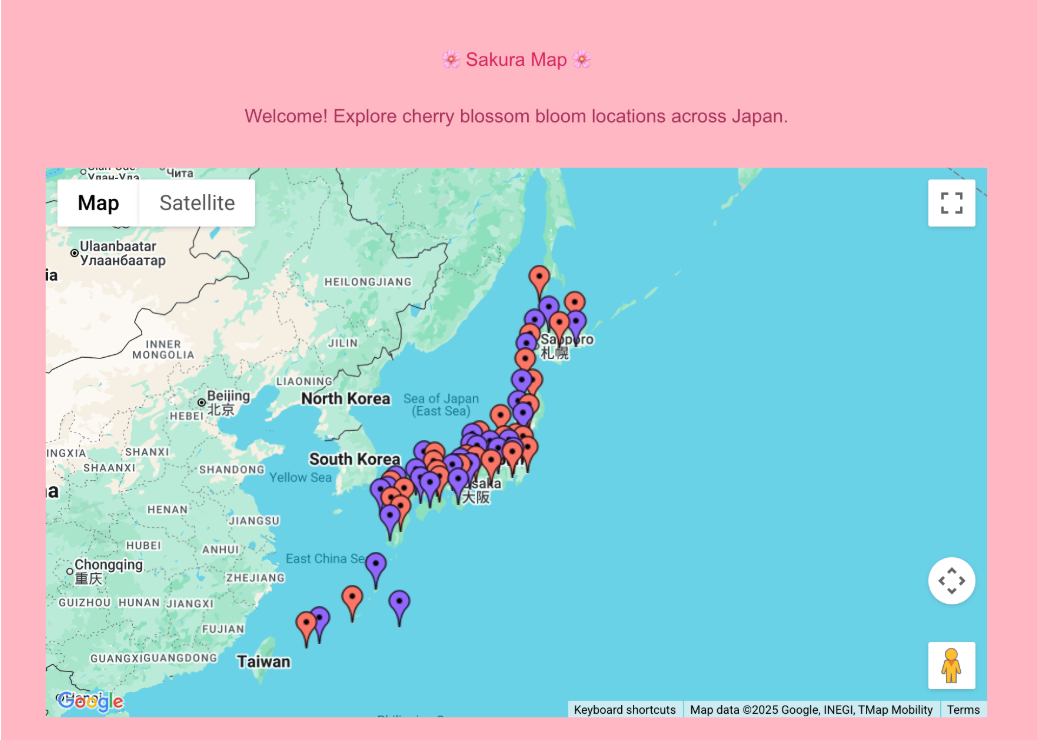
<?xml version="1.0" encoding="utf-8"?><feed xmlns="http://www.w3.org/2005/Atom" ><generator uri="https://jekyllrb.com/" version="3.10.0">Jekyll</generator><link href="https://uvicai.ca/feed.xml" rel="self" type="application/atom+xml" /><link href="https://uvicai.ca/" rel="alternate" type="text/html" /><updated>2026-02-28T05:12:02+00:00</updated><id>https://uvicai.ca/feed.xml</id><title type="html">UVicAI</title><subtitle>Uvicai club website</subtitle><author><name>UVic AI</name></author><entry><title type="html">Analyzing Sakura bloom trends in Japan</title><link href="https://uvicai.ca/2025/10/06/Hanami-prediction.html" rel="alternate" type="text/html" title="Analyzing Sakura bloom trends in Japan" /><published>2025-10-06T00:00:00+00:00</published><updated>2025-10-06T00:00:00+00:00</updated><id>https://uvicai.ca/2025/10/06/Hanami-prediction</id><content type="html" xml:base="https://uvicai.ca/2025/10/06/Hanami-prediction.html"><![CDATA[<p>Our projects attempt to <strong>Visualize Cherry Blossom Bloom Trends Across Japan</strong> by training a machine learning model on sakura flower bloom reccords and real geospacial NASA termperature and precipitation data. This project was done for the 2026 NASA Space Apps Hackathon. More information about the hackathon submission can be found on our github (button below).</p>

<!-- <img src="/assets/images/hanami_Ben.PNG" width="400"> -->

<div style="display:flex; gap:10px; align-items:flex-start;">
  <!-- Right column: two stacked landscape images -->
  <div style="display:flex; flex-direction:column; gap:10px; width:50%;">
    <img src="/assets/images/hanami_full.png" style="width:100%; border-radius:8px;" /> 
    <img src="/assets/images/hanami_Screenshot.png" style="width:100%; border-radius:8px;" />
  </div>

  <!-- Left column: portrait image -->
  <div style="width:50%;"> 
    <img src="/assets/images/hanami_Ben.PNG" style="width:100%; border-radius:6px;" /> 
  </div>
</div>

<!-- Button -->
<p>
  <a href="https://github.com/Kanahe1800/hanami-bloom-prediction" class="btn btn--primary">
    View GitHub for code
  </a>
</p>

<hr />

<h2 id="motivation">Motivation</h2>
<p>Japan attracts an average of 30–40 million tourists each year [1], many drawn by the country’s breathtaking natural scenery and particularly beautiful annual <strong>cherry blossom bloom</strong>.</p>

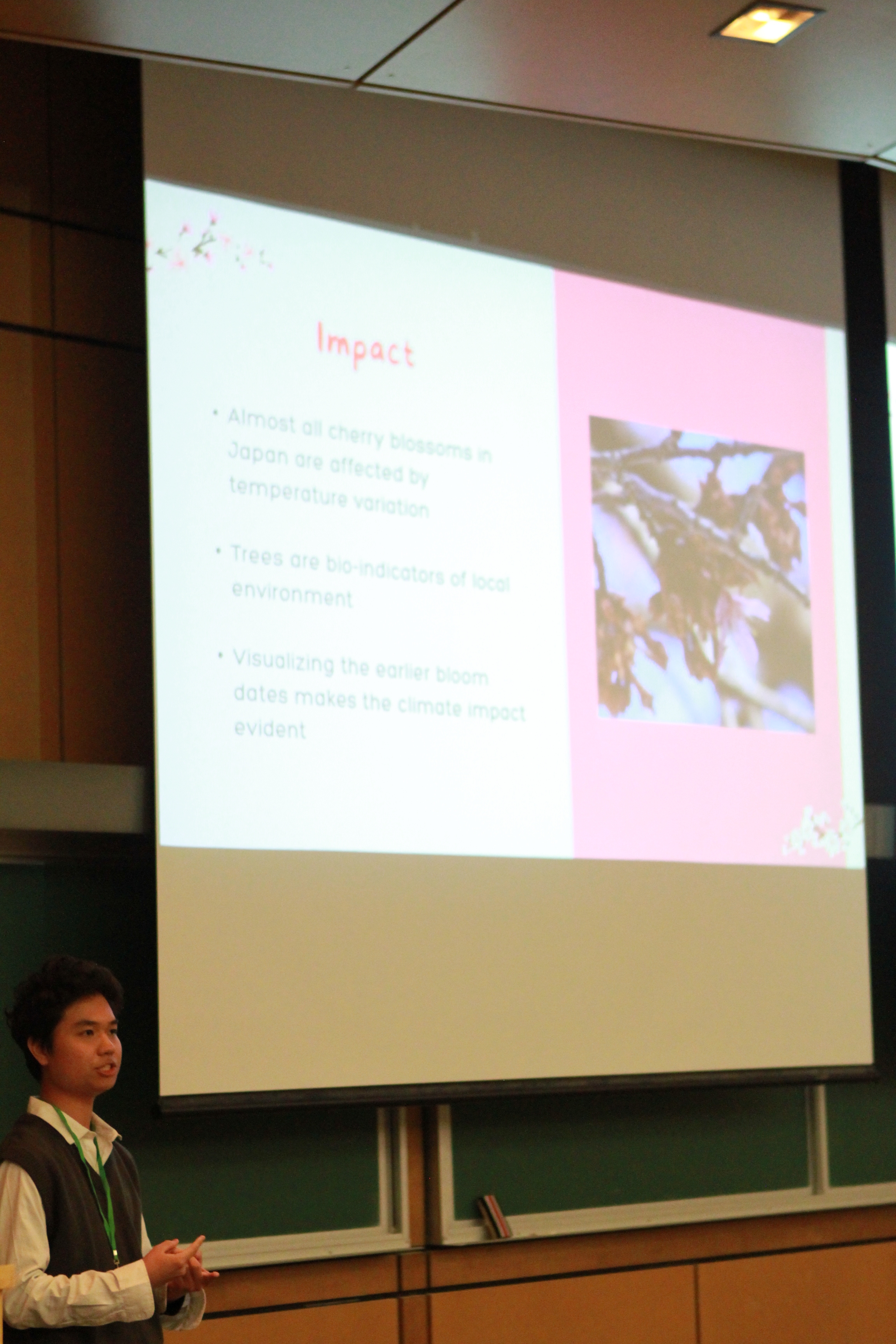
<p>Beyond tourism, bloom timing also acts as a <strong>biological sensor</strong> for environmental change. Shifts in the time of full blooming can reflect variations in temperature, precipitation, and CO₂ emissions, serving as indicators of climate change.</p>

<p>Our goal is twofold:</p>
<ol>
  <li>Help travelers find the best times to visit Japan for cherry blossoms</li>
  <li>Investigate how environmental factors influence bloom timing and plant health</li>
</ol>

<hr />
<h2 id="solution">Solution</h2>

<p>Our approach models bloom timing as a regression problem, where the target variable is the week of the year (1–52) in which sakura reach full bloom. We trained and compared multiple models, including:</p>
<ul>
  <li>Linear Regression</li>
  <li>Polynomial Regression</li>
  <li>random forest</li>
  <li>Neural Networks</li>
  <li>Random Forest Regression (best performing model) [2]</li>
</ul>

<p>To make the model accessible, we developed a simple web interface where users can:</p>
<ul>
  <li>Select a city in Japan</li>
  <li>Input or retireve relevant climate features</li>
  <li>View the predicted bloom week</li>
</ul>

<p>This allows travelers and researchers to explore how climate conditions influence bloom timing in an intuitive way.</p>

<p><img width="882" height="633" alt="Screenshot 2025-10-04 at 10 48 07 PM" src="/assets/images/hanami_Screenshot.png" /></p>

<hr />

<h2 id="methodology">Methodology</h2>
<p>We used <strong>OpenEarthData API</strong> [3] to collect environmental data for Japan, spanning 1981 to the present day, including:</p>

<ul>
  <li><strong>Monthly mean temperature (in Degrees Celcius):</strong> <code class="language-plaintext highlighter-rouge">M2SMNXSLV</code></li>
  <li><strong>Number of days with rainfall &gt;= 1mm per month:</strong> <code class="language-plaintext highlighter-rouge">M2SMNXEDI</code></li>
</ul>

<p>For each year X, we gathered data from November (X) to March (X + 1) to capture both:</p>

<ul>
  <li><strong>Spring forcing temperature</strong> – drives the onset of blooming<br />
 <strong>Winter chill requirement</strong> – ensures plants are ready for spring growth</li>
</ul>

<p>We used data from the Japan Meteorological Agency (JMA) for the historic Full bloom week records and site data.</p>

<p>We then constructed seasonal tables and visualizations to identify long-term climate patterns and their correlation with cherry blossom timing, guided by plant phenology research [4].</p>

<hr />

<h2 id="future-applications">Future Applications</h2>
<ul>
  <li>Monitoring other climate phenomenom with predictions, such as CO2 emission, N2 desposition, and photoperiod</li>
  <li>Scaling the model to other regions and plant species  accross the globe</li>
  <li>Providing tourism recommendations based on real-time environmental data</li>
</ul>

<hr />

<h2 id="references">References</h2>
<ol>
  <li><a href="https://www.tourism.jp/en/tourism-database/stats/inbound/">Japan National Tourism Organization – Inbound Statistics</a></li>
  <li><a href="https://github.com/Tristant2005/474-Sakura-Project/blob/main/474%20Final%20Report.pdf">Sakura Flower Bloom-Prediction Full Project Final Report</a></li>
  <li><a href="https://disc.gsfc.nasa.gov/datasets/M2SMNXSLV_5.12.4/summary">OpenEarthData API – MERRA-2 Dataset</a></li>
  <li><a href="https://www.frontiersin.org/journals/plant-science/articles/10.3389/fpls.2020.00443/full">Frontiers in Plant Science – Understanding Blooming Responses to Climate Change</a></li>
</ol>]]></content><author><name>UVic AI</name></author><summary type="html"><![CDATA[Our projects attempt to Visualize Cherry Blossom Bloom Trends Across Japan by training a machine learning model on sakura flower bloom reccords and real geospacial NASA termperature and precipitation data. This project was done for the 2026 NASA Space Apps Hackathon. More information about the hackathon submission can be found on our github (button below). View GitHub for code Motivation Japan attracts an average of 30–40 million tourists each year [1], many drawn by the country’s breathtaking natural scenery and particularly beautiful annual cherry blossom bloom. Beyond tourism, bloom timing also acts as a biological sensor for environmental change. Shifts in the time of full blooming can reflect variations in temperature, precipitation, and CO₂ emissions, serving as indicators of climate change. Our goal is twofold: Help travelers find the best times to visit Japan for cherry blossoms Investigate how environmental factors influence bloom timing and plant health Solution Our approach models bloom timing as a regression problem, where the target variable is the week of the year (1–52) in which sakura reach full bloom. We trained and compared multiple models, including: Linear Regression Polynomial Regression random forest Neural Networks Random Forest Regression (best performing model) [2] To make the model accessible, we developed a simple web interface where users can: Select a city in Japan Input or retireve relevant climate features View the predicted bloom week This allows travelers and researchers to explore how climate conditions influence bloom timing in an intuitive way. Methodology We used OpenEarthData API [3] to collect environmental data for Japan, spanning 1981 to the present day, including: Monthly mean temperature (in Degrees Celcius): M2SMNXSLV Number of days with rainfall &gt;= 1mm per month: M2SMNXEDI For each year X, we gathered data from November (X) to March (X + 1) to capture both: Spring forcing temperature – drives the onset of blooming Winter chill requirement – ensures plants are ready for spring growth We used data from the Japan Meteorological Agency (JMA) for the historic Full bloom week records and site data. We then constructed seasonal tables and visualizations to identify long-term climate patterns and their correlation with cherry blossom timing, guided by plant phenology research [4]. Future Applications Monitoring other climate phenomenom with predictions, such as CO2 emission, N2 desposition, and photoperiod Scaling the model to other regions and plant species accross the globe Providing tourism recommendations based on real-time environmental data References Japan National Tourism Organization – Inbound Statistics Sakura Flower Bloom-Prediction Full Project Final Report OpenEarthData API – MERRA-2 Dataset Frontiers in Plant Science – Understanding Blooming Responses to Climate Change]]></summary></entry><entry><title type="html">Learning Resources</title><link href="https://uvicai.ca/2025/05/14/learning-resources.html" rel="alternate" type="text/html" title="Learning Resources" /><published>2025-05-14T00:00:00+00:00</published><updated>2025-05-14T21:20:02+00:00</updated><id>https://uvicai.ca/2025/05/14/learning-resources</id><content type="html" xml:base="https://uvicai.ca/2025/05/14/learning-resources.html"><![CDATA[<h1 id="learning-resources">Learning Resources.</h1>

<p>For machine learning, there are so many reseources and tutorials, that when you get hit with math equation after math equation, it becomes hard to wrap your head around anything.</p>

<p>As a club, we’ve covered a lot of material over the last few years. Our members have committed themselves to understanding the material at a fundamental level, and a part of demonstrating/solidifying that knowledge is to give presentations and workshops on the topic.</p>

<p>Below is a compiled list of resources that members of our club have found useful. If you what to suggest resources, please feel free to message us via discord or email. Cheers &lt;3</p>

<h1 id="resources-list">Resources List</h1>
<h3 id="getting-started-with-ml"><a href="https://docs.google.com/document/d/1r1jlryZ60MNS2vojWSWDXSr_SUK6iT04KXZXcfTS21o/edit">Getting Started with ML</a></h3>
<h3 id="reinforcement-learning-resources"><a href="https://docs.google.com/document/d/1S1cTvFFR8cULZLmpXTZIziFjPQwRbC0Gnb7rhbYq82g/edit">Reinforcement Learning Resources</a></h3>
<h3 id="generative-ai-resources"><a href="https://docs.google.com/document/d/1pENP7M0RpyoUEqi8wVl644WqwaKCa6fl09Q8d1vR7i8/edit">Generative AI Resources</a></h3>
<h3 id="list-of-ai-safety-orgs"><a href="https://docs.google.com/document/d/1vEcK_g2rtDjmz4UUDNID8yMYwaNdBhbJgmmb-kUXamE/edit#heading=h.ko4s7x7mnytw">List of AI Safety Orgs.</a></h3>
<h3 id="ai-related-media-various-talks-or-podcasts-non-formal"><a href="https://docs.google.com/document/d/1Mu6iQb7cWuduBiO9YvKD-XRAZGI2IlkSXO3oG9dTfMI/edit?usp=sharing">AI Related Media (Various talks or podcasts, non-formal)</a></h3>

<p>Learning about utilizing neural networks, highly recommend the 3blue 1brown videos for elementary and easy-to-understand theory, and our own Colab notebooks for implementation.</p>]]></content><author><name>UVic AI</name></author><summary type="html"><![CDATA[Learning Resources. For machine learning, there are so many reseources and tutorials, that when you get hit with math equation after math equation, it becomes hard to wrap your head around anything. As a club, we’ve covered a lot of material over the last few years. Our members have committed themselves to understanding the material at a fundamental level, and a part of demonstrating/solidifying that knowledge is to give presentations and workshops on the topic. Below is a compiled list of resources that members of our club have found useful. If you what to suggest resources, please feel free to message us via discord or email. Cheers &lt;3 Resources List Getting Started with ML Reinforcement Learning Resources Generative AI Resources List of AI Safety Orgs. AI Related Media (Various talks or podcasts, non-formal) Learning about utilizing neural networks, highly recommend the 3blue 1brown videos for elementary and easy-to-understand theory, and our own Colab notebooks for implementation.]]></summary></entry><entry><title type="html">Modeling Chemical Toxicology with Machine learning</title><link href="https://uvicai.ca/2025/03/14/toxicology.html" rel="alternate" type="text/html" title="Modeling Chemical Toxicology with Machine learning" /><published>2025-03-14T00:00:00+00:00</published><updated>2025-03-14T00:00:00+00:00</updated><id>https://uvicai.ca/2025/03/14/toxicology</id><content type="html" xml:base="https://uvicai.ca/2025/03/14/toxicology.html"><![CDATA[<p>A machine learning model trained on <strong>Toxicity data</strong> [1] for over 8,000 molecules in attempt to find a relationship between <strong>molecular structure</strong> and <strong>relative toxicity</strong>. This project was then deployed along with a Streamlit web app for user interaction.</p>

<p><img src="/assets/images/toxicology.JPG" alt="Toxicology Project Secondary Image" /></p>

<p>
  <a href="https://github.com/Tristant2005/Toxicology-Prediction" class="btn btn--primary">
    View GitHub for code
  </a>
</p>

<hr />

<h2 id="-inspiration">💡 Inspiration</h2>
<p>Drug discovery remains one of the most resource‑intensive challenges in modern biomedical research. <strong>According to the American Society for Biochemistry and Molecular Biology (ASBMB)</strong> [2], approximately <strong>90% of drug candidates fail during clinical testing</strong>, with <strong>molecular toxicity accounting for nearly one‑third of these failures</strong>. These setbacks translate into billions of dollars of substantial financial losses and slow development of urgently needed therapeutics.</p>

<p>Understanding and predicting toxicity earlier in the drug development pipeline could dramatically reduce these costs. Traditional experimental approaches, while essential, are slow and expensive. Computational methods offer a promising complement, but many existing models struggle to generalize across diverse chemical structures or provide interpretable insights into why a compound may be harmful.</p>

<p>Our project addresses this challenge by:</p>
<ul>
  <li>Developing a <strong>machine learning model</strong> that predicts toxicity directly from <strong>molecular structure</strong></li>
  <li>Using <strong>Structure-Activity Relationship (SAR)</strong> principles to justify predictions based on similarity to known toxic compounds</li>
  <li>Building an <strong>interactive Streamlit app</strong> to make the model accessible for exploration and teaching</li>
</ul>

<hr />

<h2 id="️-innovation">⚛️ Innovation</h2>

<p>By integrating machine learning with chemical domain knowledge, this project explores how <strong>computational tools</strong> can support safer, more efficient drug development and help reduce the high failure rates that currently burden the pharmaceutical industry.</p>

<hr />

<h2 id="-references">📚 References</h2>
<p>[1] National Center for Advancing Translational Sciences, <em>“Toxicology in the 21st Century (Tox21)”</em>, [Online]. Available: <a href="https://tox21.gov">https://tox21.gov</a>. Accessed: Feb. 20, 2025.</p>

<p>[2] D. Sun, <em>“90% of drugs fail clinical trials”</em>, ASBMB Today, Mar. 12, 2022. [Online]. Available: <a href="https://www.asbmb.org/asbmb-today/opinions/031222/90-of-drugs-fail-clinical-trials">https://www.asbmb.org/asbmb-today/opinions/031222/90-of-drugs-fail-clinical-trials</a>. Accessed: Feb. 20, 2025.</p>]]></content><author><name>UVic AI</name></author><summary type="html"><![CDATA[A machine learning model trained on Toxicity data [1] for over 8,000 molecules in attempt to find a relationship between molecular structure and relative toxicity. This project was then deployed along with a Streamlit web app for user interaction. View GitHub for code 💡 Inspiration Drug discovery remains one of the most resource‑intensive challenges in modern biomedical research. According to the American Society for Biochemistry and Molecular Biology (ASBMB) [2], approximately 90% of drug candidates fail during clinical testing, with molecular toxicity accounting for nearly one‑third of these failures. These setbacks translate into billions of dollars of substantial financial losses and slow development of urgently needed therapeutics. Understanding and predicting toxicity earlier in the drug development pipeline could dramatically reduce these costs. Traditional experimental approaches, while essential, are slow and expensive. Computational methods offer a promising complement, but many existing models struggle to generalize across diverse chemical structures or provide interpretable insights into why a compound may be harmful. Our project addresses this challenge by: Developing a machine learning model that predicts toxicity directly from molecular structure Using Structure-Activity Relationship (SAR) principles to justify predictions based on similarity to known toxic compounds Building an interactive Streamlit app to make the model accessible for exploration and teaching ⚛️ Innovation By integrating machine learning with chemical domain knowledge, this project explores how computational tools can support safer, more efficient drug development and help reduce the high failure rates that currently burden the pharmaceutical industry. 📚 References [1] National Center for Advancing Translational Sciences, “Toxicology in the 21st Century (Tox21)”, [Online]. Available: https://tox21.gov. Accessed: Feb. 20, 2025. [2] D. Sun, “90% of drugs fail clinical trials”, ASBMB Today, Mar. 12, 2022. [Online]. Available: https://www.asbmb.org/asbmb-today/opinions/031222/90-of-drugs-fail-clinical-trials. Accessed: Feb. 20, 2025.]]></summary></entry><entry><title type="html">AI Ethics Reading Group</title><link href="https://uvicai.ca/2024/06/18/AI-Ethics-Reading-Group.html" rel="alternate" type="text/html" title="AI Ethics Reading Group" /><published>2024-06-18T00:00:00+00:00</published><updated>2024-06-18T00:00:00+00:00</updated><id>https://uvicai.ca/2024/06/18/AI-Ethics-Reading-Group</id><content type="html" xml:base="https://uvicai.ca/2024/06/18/AI-Ethics-Reading-Group.html"><![CDATA[<h3 id="note-this-reading-group-does-no-longer-run-with-sufficient-interest-we-can-bring-this-back-feel-free-to-email-us-if-you-want-this-to-come-back">Note: This reading group does no longer run. With sufficient interest we can bring this back. Feel free to email us if you want this to come back.</h3>

<p>Ethical use and development of AI is one of the core values UVic AI seeks to promote. Visit <a href="https://discord.com/channels/667187914781884421/979147716879872130">our ethics channel</a> on discord for links and discussion on ethics topics. Visit <a href="https://discord.com/channels/667187914781884421/1023737863407407194">our announcements channel</a> for upcoming AI Ethics events including online meetings and in person events on campus.</p>

<p><ins>Reading Group</ins></p>

<p>We have been hosting a reading group since the summer of 2023 focusing on AI safety research, including value alignment, interpretability, AI governance, and societal impact. You can view a list of our topics below, and browse <a href="https://discord.com/channels/667187914781884421/1107810310963855461">our reading-group channel</a> to view our notes from each session.</p>

<!-- Anyone who is interested in these topics is more than welcome to join our online meetings, regardless of their knowledge background or location! -->

<!-- - Intro to AI Ethics & Alignment: Every Monday at 7pm, [online](https://uvic.zoom.us/j/87151396555) -->
<!-- - Advanced AI Ethics & General Topics: Every Wednesday at 7pm, [online](https://uvic.zoom.us/j/87151396555) -->
<!-- <ins>Reading Group Mailing List:</ins> [Sign up](https://forms.gle/Tf5G2Cxn3XmbLLyP9) -->

<p><ins>Reading Session History:</ins></p>

<ul>
  <li>Session 42 - Mon, Jun 3: Discussion: consciousness, in machines and people.</li>
  <li>Session 41 - Mon, May 27: Intro to Intelligence Explosions</li>
  <li>Session 40 - Mon, May 20: <a href="https://transformer-circuits.pub/2021/framework/index.html">A Mathematical Framework for Transformer Circuits</a></li>
  <li>Session 39 - Mon, May 13: “When will we know AI is concious?” by Exurbia</li>
  <li>Session 38 - Mon, Mar 25: AI Policy</li>
  <li>Session 37 - Wed, Mar 20: Intro to Agent Foundations</li>
  <li>Session 36 - Mon, Mar 4: Free topic.</li>
  <li>
    <p>Session 35 - Wed, Feb 28: <a href="https://arxiv.org/abs/2309.02390">Explaining grokking through circuit efficiency</a></p>
  </li>
  <li>
    <p>Session 34 - Mon, Feb 26: <a href="https://forum.effectivealtruism.org/posts/av3cCGiDzGt3ko3Tf/gentleness-and-the-artificial-other">Gentleness and the Artificial Other</a></p>
  </li>
  <li>Session 33 - Wed, Feb 21: <a href="https://transformer-circuits.pub/2021/framework/index.html">Mathematical Framework for Transformer Circuits</a></li>
  <li>Session 32 - Mon, Feb 19: We’re reading and discussing the <a href="https://arxiv.org/abs/2208.11173">Alberta plan for AI</a></li>
  <li>Session 31 - Wed, Feb 14: <a href="https://www.biorxiv.org/content/10.1101/2022.11.18.517004v2">High-resolution image reconstruction with latent diffusion models from human brain activity</a></li>
  <li>Session 30 - Mon, Feb 12: Section 2 of <a href="https://intelligence.org/files/CEV.pdf">Coherent Extrapolated Volition</a></li>
  <li>Session 29 - Wed, Feb 7: <a href="https://deepmindsafetyresearch.medium.com/goal-misgeneralisation-why-correct-specifications-arent-enough-for-correct-goals-cf96ebc60924">Goal Misgeneralisation: Why Correct Specifications Aren’t Enough For Correct Goals</a></li>
  <li>Session 28 - Mon, Feb 5: Open discussion on AI Ethics topics</li>
  <li>Session 27 - Wed, Jan 31: “<a href="https://arxiv.org/abs/2201.02177">Grokking: Generalization Beyond Overfitting on Small Algorithmic Datasets</a>”</li>
  <li>Session 26 - Mon, Jan 29: Overview and discussion of AI Ethics &amp; Alignment</li>
  <li>Session 25 - 2024, Dec 4th: Reading about the UK “AI Safety Summit 2023”</li>
  <li>Session 24 - Nov 27th: <a href="https://arxiv.org/pdf/1905.04899.pdf">CutMix: Regularization Strategy to Train Strong Classifiers with Localizable Features</a></li>
  <li>Session 23 - Nov 20th: We’re reading about transformers and precursors / prerequisites leading up to them using <a href="https://www.reddit.com/r/MachineLearning/comments/pkedi4/d_resources_for_understanding_the_original/">this post</a> as a jumping off point.</li>
  <li>Session 22 - Nov 13th: A second week of discussing <a href="https://www.alignmentforum.org/posts/N6WM6hs7RQMKDhYjB/a-mechanistic-interpretability-analysis-of-grokking">A Mechanistic Interpretability Analysis of Grokking</a></li>
  <li>Session 21 - Nov 6th: <a href="https://www.alignmentforum.org/posts/N6WM6hs7RQMKDhYjB/a-mechanistic-interpretability-analysis-of-grokking">A Mechanistic Interpretability Analysis of Grokking</a></li>
  <li>Session 20 - Oct 30th: Curiosity: <a href="https://arxiv.org/abs/1810.12894">Exploration by Random Network Distillation (paper)</a> with <a href="https://www.youtube.com/watch?v=CIDRdLOWrXQ">2min papers summary vid</a></li>
  <li>Session 19 - Oct 23th: MuZero: <a href="https://discord.com/channels/667187914781884421/1107810310963855461/1163709113709109318">MuZero blog article</a>, <a href="https://discord.com/channels/667187914781884421/1107810310963855461/1163709113709109318">MuZero paper</a>, and <a href="https://discord.com/channels/667187914781884421/1107810310963855461/1163709113709109318">DreamerV3 paper</a></li>
  <li>Session 18 - Oct 16th: <a href="https://distill.pub/2020/circuits/zoom-in/">Zoom In: An Introduction to Circuits</a> (from Claim 2 until the end)</li>
  <li>Session 17 - Oct 9th: <a href="https://distill.pub/2020/circuits/zoom-in/">Zoom In: An Introduction to Circuits</a> (until the end of Claim 1)</li>
  <li>Session 16 - Oct 2nd: <a href="https://www.alignmentforum.org/posts/LbrPTJ4fmABEdEnLf/200-concrete-open-problems-in-mechanistic-interpretability">200 Concrete Open Problems in Mechanistic Interpretability: Introduction</a></li>
  <li>Session 15 - Sept 25th: <a href="https://80000hours.org/problem-profiles/artificial-intelligence/">Preventing an AI-related catastrophe</a> (sections 4 - 6)</li>
  <li>Session 14 - Sept 18th: <a href="https://80000hours.org/problem-profiles/artificial-intelligence/">Preventing an AI-related catastrophe</a> (sections 1 - 3)</li>
  <li>Session 13 - Sept 11th: <a href="https://forum.effectivealtruism.org/posts/D4khSueGA4Trebkks/crosspost-an-ai-pause-is-humanity-s-best-bet-for-preventing">An AI Pause Is Humanity’s Best Bet For Preventing Extinction</a></li>
  <li>Session 12 - Aug 8th: <a href="https://openai.com/blog/introducing-superalignment">OpenAI’s Superalignment team/goal</a> (This week we will discuss this topic generally, so choose whichever reading or podcast you wish in order to learn more about it)</li>
  <li>Session 11 - Aug 1st: <a href="https://www.lesswrong.com/posts/QBAjndPuFbhEXKcCr/my-understanding-of-what-everyone-in-technical-alignment">(My understanding of) What Everyone in Technical Alignment is Doing and Why</a> (round 2)</li>
  <li>Session 10 - July 25th: <a href="https://www.lesswrong.com/posts/QBAjndPuFbhEXKcCr/my-understanding-of-what-everyone-in-technical-alignment">(My understanding of) What Everyone in Technical Alignment is Doing and Why</a></li>
  <li>Session 9 - July 18th: Self-appointed skim reading from our list of suggested readings. This week we will all individually choose a few suggested readings from <a href="https://docs.google.com/document/d/1N7eh8T8uuG3CexuZIGOt5H2n92-itLl_l-0H8KgvgGA/edit">this document</a> to skim read through. During our discussion we will each pitch some of the readings we surveyed and collectively decide on which one sounds the most interesting to fully read for the following week.</li>
  <li>Session 8 - July 11th: <a href="https://www.lesswrong.com/posts/WKGZBCYAbZ6WGsKHc/love-in-a-simbox-is-all-you-need#5__Simboxing__easy_and_necessary">LOVE in a simbox is all you need</a></li>
  <li>Session 7 - July 4th: Self-appointed AI-optimist reading(s). This week we will all individually choose 1 or more readings that go against the “AI doomer” belief that AGI poses a sufficient risk of existential catastrophe such that we need to take AI safety very seriously.</li>
  <li>Session 6 - June 27th: <a href="https://www.lesswrong.com/posts/A9NxPTwbw6r6Awuwt/how-likely-is-deceptive-alignment">How likely is deceptive alignment?</a></li>
  <li>Session 5 - June 20th: <a href="https://transformer-circuits.pub/2022/mech-interp-essay/index.html">Mechanistic Interpretability, Variables, and the Importance of Interpretable Bases</a></li>
  <li>Session 4 - June 13th: <a href="https://www.anthropic.com/index/core-views-on-ai-safety">Core Views on AI Safety: When, Why, What, and How</a></li>
  <li>Session 3 - June 6th: <a href="https://arxiv.org/abs/2305.08746">Seeing is Believing: Brain-Inspired Modular Training for Mechanistic Interpretability</a> (round 2) and <a href="https://deepmindsafetyresearch.medium.com/alignment-of-language-agents-9fbc7dd52c6c">Alignment of Language Agents</a></li>
  <li>Session 2 - May 30th: <a href="https://arxiv.org/abs/2305.08746">Seeing is Believing: Brain-Inspired Modular Training for Mechanistic Interpretability</a></li>
  <li>Session 1 - 2023, May 23rd: <a href="https://forum.effectivealtruism.org/posts/63stBTw3WAW6k45dY/paul-christiano-current-work-in-ai-alignment">Paul Christiano: Current work in AI alignment</a></li>
</ul>]]></content><author><name>UVic AI</name></author><summary type="html"><![CDATA[Note: This reading group does no longer run. With sufficient interest we can bring this back. Feel free to email us if you want this to come back. Ethical use and development of AI is one of the core values UVic AI seeks to promote. Visit our ethics channel on discord for links and discussion on ethics topics. Visit our announcements channel for upcoming AI Ethics events including online meetings and in person events on campus. Reading Group We have been hosting a reading group since the summer of 2023 focusing on AI safety research, including value alignment, interpretability, AI governance, and societal impact. You can view a list of our topics below, and browse our reading-group channel to view our notes from each session. Reading Session History: Session 42 - Mon, Jun 3: Discussion: consciousness, in machines and people. Session 41 - Mon, May 27: Intro to Intelligence Explosions Session 40 - Mon, May 20: A Mathematical Framework for Transformer Circuits Session 39 - Mon, May 13: “When will we know AI is concious?” by Exurbia Session 38 - Mon, Mar 25: AI Policy Session 37 - Wed, Mar 20: Intro to Agent Foundations Session 36 - Mon, Mar 4: Free topic. Session 35 - Wed, Feb 28: Explaining grokking through circuit efficiency Session 34 - Mon, Feb 26: Gentleness and the Artificial Other Session 33 - Wed, Feb 21: Mathematical Framework for Transformer Circuits Session 32 - Mon, Feb 19: We’re reading and discussing the Alberta plan for AI Session 31 - Wed, Feb 14: High-resolution image reconstruction with latent diffusion models from human brain activity Session 30 - Mon, Feb 12: Section 2 of Coherent Extrapolated Volition Session 29 - Wed, Feb 7: Goal Misgeneralisation: Why Correct Specifications Aren’t Enough For Correct Goals Session 28 - Mon, Feb 5: Open discussion on AI Ethics topics Session 27 - Wed, Jan 31: “Grokking: Generalization Beyond Overfitting on Small Algorithmic Datasets” Session 26 - Mon, Jan 29: Overview and discussion of AI Ethics &amp; Alignment Session 25 - 2024, Dec 4th: Reading about the UK “AI Safety Summit 2023” Session 24 - Nov 27th: CutMix: Regularization Strategy to Train Strong Classifiers with Localizable Features Session 23 - Nov 20th: We’re reading about transformers and precursors / prerequisites leading up to them using this post as a jumping off point. Session 22 - Nov 13th: A second week of discussing A Mechanistic Interpretability Analysis of Grokking Session 21 - Nov 6th: A Mechanistic Interpretability Analysis of Grokking Session 20 - Oct 30th: Curiosity: Exploration by Random Network Distillation (paper) with 2min papers summary vid Session 19 - Oct 23th: MuZero: MuZero blog article, MuZero paper, and DreamerV3 paper Session 18 - Oct 16th: Zoom In: An Introduction to Circuits (from Claim 2 until the end) Session 17 - Oct 9th: Zoom In: An Introduction to Circuits (until the end of Claim 1) Session 16 - Oct 2nd: 200 Concrete Open Problems in Mechanistic Interpretability: Introduction Session 15 - Sept 25th: Preventing an AI-related catastrophe (sections 4 - 6) Session 14 - Sept 18th: Preventing an AI-related catastrophe (sections 1 - 3) Session 13 - Sept 11th: An AI Pause Is Humanity’s Best Bet For Preventing Extinction Session 12 - Aug 8th: OpenAI’s Superalignment team/goal (This week we will discuss this topic generally, so choose whichever reading or podcast you wish in order to learn more about it) Session 11 - Aug 1st: (My understanding of) What Everyone in Technical Alignment is Doing and Why (round 2) Session 10 - July 25th: (My understanding of) What Everyone in Technical Alignment is Doing and Why Session 9 - July 18th: Self-appointed skim reading from our list of suggested readings. This week we will all individually choose a few suggested readings from this document to skim read through. During our discussion we will each pitch some of the readings we surveyed and collectively decide on which one sounds the most interesting to fully read for the following week. Session 8 - July 11th: LOVE in a simbox is all you need Session 7 - July 4th: Self-appointed AI-optimist reading(s). This week we will all individually choose 1 or more readings that go against the “AI doomer” belief that AGI poses a sufficient risk of existential catastrophe such that we need to take AI safety very seriously. Session 6 - June 27th: How likely is deceptive alignment? Session 5 - June 20th: Mechanistic Interpretability, Variables, and the Importance of Interpretable Bases Session 4 - June 13th: Core Views on AI Safety: When, Why, What, and How Session 3 - June 6th: Seeing is Believing: Brain-Inspired Modular Training for Mechanistic Interpretability (round 2) and Alignment of Language Agents Session 2 - May 30th: Seeing is Believing: Brain-Inspired Modular Training for Mechanistic Interpretability Session 1 - 2023, May 23rd: Paul Christiano: Current work in AI alignment]]></summary></entry><entry><title type="html">Wildfire Prediction</title><link href="https://uvicai.ca/2024/04/18/Wildfire-Prediction.html" rel="alternate" type="text/html" title="Wildfire Prediction" /><published>2024-04-18T19:34:30+00:00</published><updated>2024-04-18T19:34:30+00:00</updated><id>https://uvicai.ca/2024/04/18/Wildfire-Prediction</id><content type="html" xml:base="https://uvicai.ca/2024/04/18/Wildfire-Prediction.html"><![CDATA[<p>Simulating Responsive Action to Wildfire Disasters with Reinforcement Learning (RL)</p>

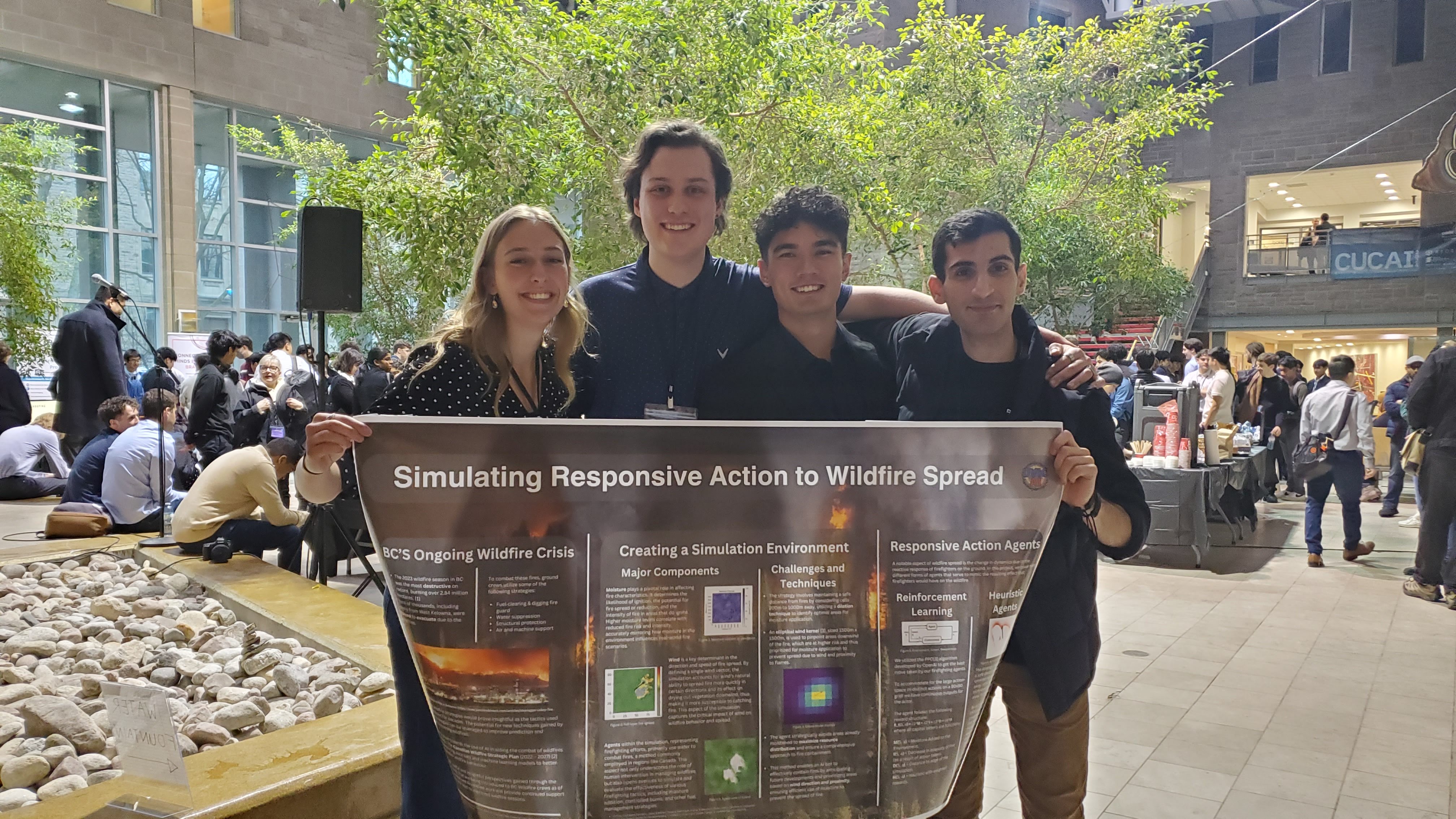
<p><img src="/assets/images/wildfire_group_img.jpg" alt="Wildfire Management - CUCAI 2024" /></p>

<p><a href="https://github.com/uvicaiclub/WildfireManagementRL" class="btn btn--primary">
  View GitHub for Code
</a></p>

<h2 id="-motivation">💖 Motivation</h2>
<p>Wildfires are among the most <strong>destructive natural hazards</strong> in Western Canada, contributing significantly to air pollution, ecological damage, and threats to human communities. In British Columbia, annual fire suppression costs are approaching <strong>one billion dollars</strong>, and the scale and intensity of fires continue to increase due to <strong>climate change</strong>.</p>

<p>Developing <strong>intelligent</strong>, <strong>adaptive</strong>, and <strong>cost‑effective wildfire response strategies</strong> is becoming essential. Traditional planning methods struggle to keep pace with the complexity of modern fire behavior, making this an ideal domain for <strong>machine learning research</strong>.</p>

<hr />

<h2 id="-background">📝 Background</h2>
<p>A variety of fire spread simulators exist today, many of which incorporate <strong>environmental factors</strong> such as:</p>

<ul>
  <li>Terrain elevation</li>
  <li>Wind speed and direction</li>
  <li>Vegetation and fuel type</li>
</ul>

<p>These tools are invaluable for <strong>forecasting fire behavior</strong>, but they generally treat the fire as an uncontrolled physical process. Human intervention—arguably the most important variable in real wildfire response—is often missing from the simulation loop.</p>

<p>Previous research has attempted to introduce <strong>reinforcement learning (RL)</strong> agents into wildfire environments, but these efforts face two major limitations:</p>

<ul>
  <li>The simulators used are often too simplified to reflect real fire dynamics</li>
  <li>The available agent actions rarely resemble the operational decisions made by actual fire crews</li>
</ul>

<p>As a result, RL agents may learn strategies that perform well in simulation but fail to translate to real‑world scenarios.</p>

<hr />

<h2 id="-our-contributions">💡 Our Contributions</h2>
<p>Our project seeks to bridge this gap by developing an <strong>RL environment informed by modern fire spread simulators</strong>:</p>

<ul>
  <li>Parameters of spread dynamics are tuned to reflect <strong>realistic fire behavior in Northwestern BC</strong></li>
  <li><strong>Multiple RL agents</strong> are trained to fight wildfires cooperatively</li>
  <li>Agent actions are modeled after <strong>actual fire crew operations</strong>, making simulations more realistic and operationally relevant</li>
</ul>

<hr />

<p>🔥 This project explores how <strong>AI-driven strategies</strong> could one day assist in minimizing damage, reducing costs, and saving lives during wildfire disasters.</p>]]></content><author><name>UVic AI</name></author><summary type="html"><![CDATA[Simulating Responsive Action to Wildfire Disasters with Reinforcement Learning (RL) View GitHub for Code 💖 Motivation Wildfires are among the most destructive natural hazards in Western Canada, contributing significantly to air pollution, ecological damage, and threats to human communities. In British Columbia, annual fire suppression costs are approaching one billion dollars, and the scale and intensity of fires continue to increase due to climate change. Developing intelligent, adaptive, and cost‑effective wildfire response strategies is becoming essential. Traditional planning methods struggle to keep pace with the complexity of modern fire behavior, making this an ideal domain for machine learning research. 📝 Background A variety of fire spread simulators exist today, many of which incorporate environmental factors such as: Terrain elevation Wind speed and direction Vegetation and fuel type These tools are invaluable for forecasting fire behavior, but they generally treat the fire as an uncontrolled physical process. Human intervention—arguably the most important variable in real wildfire response—is often missing from the simulation loop. Previous research has attempted to introduce reinforcement learning (RL) agents into wildfire environments, but these efforts face two major limitations: The simulators used are often too simplified to reflect real fire dynamics The available agent actions rarely resemble the operational decisions made by actual fire crews As a result, RL agents may learn strategies that perform well in simulation but fail to translate to real‑world scenarios. 💡 Our Contributions Our project seeks to bridge this gap by developing an RL environment informed by modern fire spread simulators: Parameters of spread dynamics are tuned to reflect realistic fire behavior in Northwestern BC Multiple RL agents are trained to fight wildfires cooperatively Agent actions are modeled after actual fire crew operations, making simulations more realistic and operationally relevant 🔥 This project explores how AI-driven strategies could one day assist in minimizing damage, reducing costs, and saving lives during wildfire disasters.]]></summary></entry><entry><title type="html">Reinforcement Learning for Battlesnake</title><link href="https://uvicai.ca/2023/04/18/BattlesnakeRL.html" rel="alternate" type="text/html" title="Reinforcement Learning for Battlesnake" /><published>2023-04-18T19:34:30+00:00</published><updated>2023-04-18T19:34:30+00:00</updated><id>https://uvicai.ca/2023/04/18/BattlesnakeRL</id><content type="html" xml:base="https://uvicai.ca/2023/04/18/BattlesnakeRL.html"><![CDATA[<p>UVic AI’s primary project is using reinforcement learning to build a top competitor in the game Battlesnake. Battlesnake is an internationally played game in which 4 snakes fight for survival in a digital environment. Each turn, every snake’s code is sent the complete state of the environment and given 500ms to compute and submit their next move. To train in this multi-agent synchronous game environment, we have built a modified Monte Carlo Tree Search algorithm that trains via self-play (inspired by AlphaZero). Our current model is at an intermediate level of play and showing no signs of diminishing returns.</p>

<p>Our paper, as it was submitted to CUCAI 2023.</p>

<p>Our future goals are to improve the interpretability of this RL model, to implement Random Network Distillation and other MCTS modifications, and to scale up training until we’re first place on the leaderboard.</p>

<p>We also help those with less programming experience write their first battlesnakes using basic heuristics during the lead-up to seasonal Battlesnake tournaments.</p>]]></content><author><name>UVic AI</name></author><summary type="html"><![CDATA[UVic AI’s primary project is using reinforcement learning to build a top competitor in the game Battlesnake. Battlesnake is an internationally played game in which 4 snakes fight for survival in a digital environment. Each turn, every snake’s code is sent the complete state of the environment and given 500ms to compute and submit their next move. To train in this multi-agent synchronous game environment, we have built a modified Monte Carlo Tree Search algorithm that trains via self-play (inspired by AlphaZero). Our current model is at an intermediate level of play and showing no signs of diminishing returns. Our paper, as it was submitted to CUCAI 2023. Our future goals are to improve the interpretability of this RL model, to implement Random Network Distillation and other MCTS modifications, and to scale up training until we’re first place on the leaderboard. We also help those with less programming experience write their first battlesnakes using basic heuristics during the lead-up to seasonal Battlesnake tournaments.]]></summary></entry></feed>